guide
Cap d’Agde is probably the best-known name in French naturism, and also the most misunderstood. Behind the image lies a family story, an entire quarter designed for living naked, and a mixed reputation that is worth knowing about before you book. For the basics, see our guide to naturist camping.
In 1956, René and Paul Oltra, two winegrowing brothers, opened a helio-marine centre on their land by the Mediterranean. The first bungalows welcomed naturist holidaymakers in 1958. When the French state launched the tourist development of the Languedoc coast, Paul Oltra secured the inclusion of a naturist quarter at Cap d’Agde: in 1973, the beach was officially designated as naturist. Apartments, a harbour and shops were then built around the historic campsite, forming today’s naturist quarter.
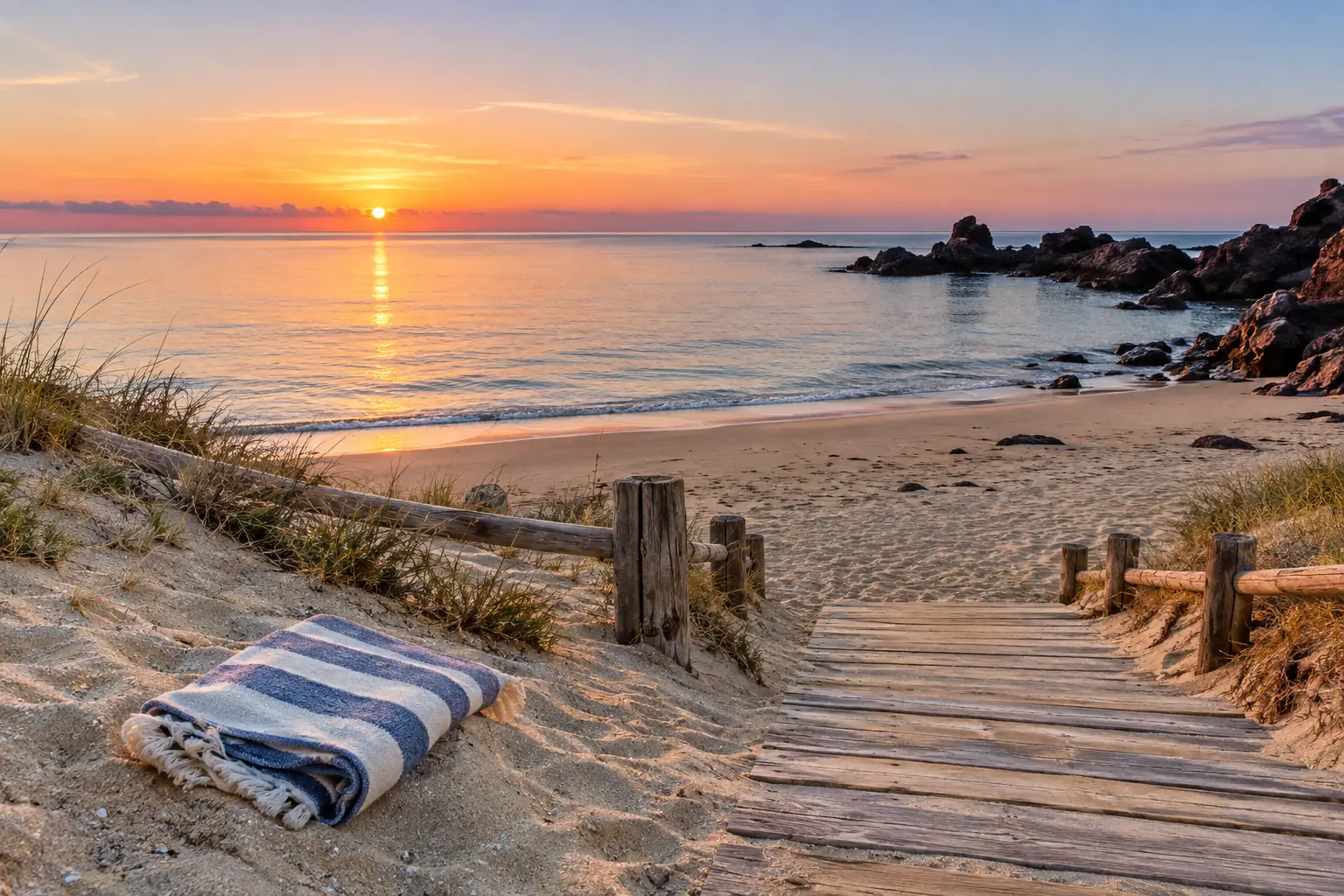
The quarter is a small town in its own right: campsite, residences and apartments, shops, restaurants and bars, all opening onto a sandy beach of around 2 kilometres. The principle is simple: nudity is the norm, in the streets as on the beach. You enter through a dedicated entrance, and admission conditions vary by accommodation: since 2009, the Centre René Oltra has required guests staying at its campsite, villas and apartments to be members of a naturist organisation.
The natural setting matters too: the quarter borders the Bagnas nature reserve, a protected lagoon where many birds can be observed.
It would be dishonest not to mention it. Part of the quarter is also home to a swinger scene, with a few dedicated venues, and it sometimes spills over onto the beach. This has led some naturists to prefer more family-oriented destinations. These practices have nothing to do with naturism, which is based on non-sexual nudity.
In practice, for a family stay:
If the atmosphere of a large resort does not appeal, the Hérault coast offers a quieter alternative: Le Sérignan Plage Nature opens directly onto a naturist beach backed by a protected dune belt.
Direct heir to the Oltra story, the Centre naturiste René Oltra now covers 39 hectares with a 4-star rating, about a hundred metres from the beach. It offers pitches and rentals, a seawater pool built as early as 1966, and opens every year from 15 March to 15 October, making it a good option for an off-season stay.
Find the department’s sites on our page naturist campsites in the Hérault and, for the region, in Occitanie.
The Oltra brothers’ centre opened in 1956 and welcomed its first naturists in 1958. The quarter’s beach was officially designated as naturist in 1973.
Yes, provided you choose your accommodation carefully: part of the quarter has a libertine reputation. A site that explicitly promotes family naturism, such as the Centre René Oltra, remains the safest choice.
It depends on the accommodation. Since 2009, the Centre René Oltra has required its guests to be members of a naturist organisation. Check the conditions when booking.
Around 2 kilometres of sand, bordering the naturist quarter.
From 15 March to 15 October, so you can enjoy Cap d’Agde outside the high season.