
guide
A holiday without swimwear is as intriguing as it is daunting. Do you need a card, what does the law say, how should you behave, what if you feel uncomfortable? This guide answers these questions using the sites’ own house rules, official texts and our selection of 100 naturist campsites, so that your first stay goes smoothly.
Its official definition, adopted in 1974 in Agde by the International Naturist Federation, fits in one sentence: “a way of life in harmony with nature, characterised by the practice of communal nudity, with the intention of encouraging self-respect, respect for others and for the environment”. These values go beyond clothing: a simple relationship with the body, with the outdoors and a real sense of freedom.
At a campsite, these values translate into very concrete things: respect for other holidaymakers and their peace and quiet, respect for nature and the natural area around the site, care for the environment. Several sites have made this a verifiable commitment, such as Riva Bella, which holds the EU Ecolabel and the Qualité Tourisme label, or Arnaoutchot, which holds the Green Key label. These values of freedom and simplicity also explain why most naturist campsites lie in the heart of nature, far from towns.
The nudity is social, never sexual: people swim, play pétanque or do their shopping without clothes because it is simpler and more pleasant, not to show off. The sites make sure of it: voyeurism or exhibitionism is grounds for exclusion.
It is far from marginal. According to an Ipsos survey carried out for the French Naturist Federation in February 2025, 12% of French people aged 18 to 75 have already stayed at a naturist holiday centre, and the rate is higher among younger people. 70% of respondents see it as a philosophy of life.
France has a long history here. The village of Héliopolis, on the Île du Levant, was founded in 1931. In 1950, Albert Lecocq created Europe’s first naturist holiday centre in Montalivet, today CHM Monta, and the same year founded the French Naturist Federation (FFN). The Médoc is also home to Euronat, described as the largest naturist village in Europe, with 335 hectares of pine forest.
The French Criminal Code does not punish nudity as such, but “sexual exhibition imposed on others in a place open to public view” (article 222-32), which carries up to one year in prison and a €15,000 fine. In practice, the courts distinguish naturist, non-sexual nudity from exhibitionism.
Nudity is therefore safe in three settings:
A few metres beyond the edge of an authorised beach, the same nudity can become an offence again. Check with the town hall or tourist office before settling in, and follow the signs.
Not all naturist places are alike. The choice mainly depends on the atmosphere you are looking for and the level of comfort you expect.
| Type | What you will find | Best for |
|---|---|---|
| Members’ club | Grounds run by volunteers, often affiliated with the FFN, village atmosphere, moderate prices | Those looking for calm and a community spirit |
| Naturist campsite | Pitches, mobile homes or chalets, pool, the usual campsite services | Families and couples, first experience |
| Holiday village or centre | Large estate with shops, restaurants, entertainment, spa, sometimes direct beach access | Those who want everything on site, longer stays |
FFN or FEN? The French Naturist Federation (FFN) brings together approved clubs and centres and issues the naturist card. The Fédération des espaces naturistes (FEN) is a label shared by around thirty commercial sites committed to an ethics charter. In our selection, 70 of the 100 sites state that they are affiliated with the FFN; the others are independent or belong to another network, which says nothing about how reliable they are.
Is the card compulsory? Not always. The FFN card, which includes the International Naturist Federation (INF-FNI) stamp valid abroad, is required by clubs and some centres. Most commercial campsites offer a discovery pass to holidaymakers who do not have one. Check the rule when you book.
What if you travel alone? Families and couples are welcome everywhere. So are people travelling alone, but several sites ask them for a card or an introduction beforehand: a precaution to protect the family atmosphere, not an exclusion. A few sites, on the other hand, are adults only, such as LPC Naturist Accommodation & Camping in the Mayenne or Château Guiton in the Gironde.
Every site has its house rules, displayed at reception. The same principles almost always apply.
Some campsites have a clothed area or leave the choice open in part of the grounds. This is the case for 7 sites in our selection, including Arnaoutchot in the Landes and La Chiappa in Corsica: a good transition for a couple or family where someone is still hesitant.
Feeling awkward in the first few minutes is normal and passes quickly: when everyone is naked, nobody looks any more. A few choices make it easier.
With children, naturism usually comes very naturally: little ones often adapt faster than their parents. Teenagers may prefer to stay covered for a while; most house rules allow it. 26 sites in our selection have a kids’ club and 22 a paddling pool.
Our catalogue lists 100 naturist campsites across 13 regions. Three main types of destination stand out.
The Atlantic. The Médoc and Landes coast gathers the large estates under the pines, with direct access to naturist beaches: CHM Monta, Euronat, La Jenny or Arnaoutchot. Nouvelle-Aquitaine has 20 sites in our selection.
The Mediterranean. By the sea on the Languedoc-Roussillon coast, Cap d’Agde and its Centre René Oltra form the best-known naturist quarter in Europe. Occitanie is the leading region in our selection with 26 sites. In Provence-Alpes-Côte d’Azur (11 sites), you can alternate between the coves of the Var, the Provençal hinterland and the lakes of the Alpes-de-Haute-Provence around the Verdon. The season is longer and the water warmer than elsewhere.
Spotlight on Sérignan Plage Nature. By the sea on the Hérault coast, in Languedoc, Le Sérignan Plage Nature opens directly onto a fine-sand naturist beach, within a dune belt protected by the Conservatoire du littoral and awarded the Blue Flag. Naturism has been practised there since 1972. A useful option for first-timers: a “Discover naturism” package lets you stay on the clothed side, at the neighbouring campsite, with unlimited pedestrian access to the naturist site. Guests of the naturist campsite can in turn use some of the neighbouring campsite’s facilities at no extra cost.
Corsica. The island has 8 sites in our selection, mostly on the east coast between Bastia and Porto-Vecchio. At Linguizzetta, the naturist estate of ‘+RB+’ covers 70 hectares between the sea and the Terrenzana lagoon, with 199 pitches, 90 rental units, direct access to the sea and a 500 m² thalasso area. Open since 1963, Riva Bella is one of the historic addresses of naturism in Corsica. Another flagship, Bagheera, opens from February to November. To choose your naturist campsite in Corsica, see our guide to naturist Corsica.
Countryside and mountains. This is the least-known face of naturism: 71 of the 100 sites are in the countryside and 9 in the mountains, often smaller and quieter. Rivers, lakes and gorges, as at Domaine de la Sablière in the Cèze gorges, replace the beach. Auvergne-Rhône-Alpes has 6 sites in the selection. Further north, the Pays de la Loire (5 sites, including Le Colombier in the Vendée and Mayenne Nature), Brittany and Normandy offer a more low-key naturism, deep in the countryside.
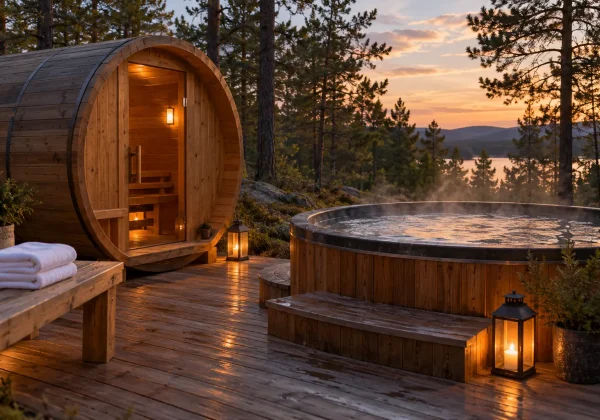
A naturist campsite offers the same services as a conventional campsite, with more room for well-being. In our selection, 43 sites have a sauna, 34 a heated pool, 32 offer massages and 12 a jacuzzi. Petanque (81 sites), hiking (66), table tennis (65) and volleyball (45) lead the activities, alongside yoga (19) and aqua aerobics (17). For accommodation, the pitch remains the basis, but you will also find mobile homes and chalets.
For accommodation, the choice ranges from a pitch for a tent, caravan or camper van to renting a mobile home, a chalet or a lodge tent. A few sites also offer guest rooms, such as Rêve de Poulaines in the Centre-Val de Loire. For a first experience, renting saves you from bringing everything.
For services, wifi is free at 67 sites in our selection and paid at 7 others; 45 have an on-site restaurant, 35 a playground for children and 9 a games room. The largest estates add a mini-market, evening entertainment or a thalasso area, as at Euronat and Riva Bella: see our article on naturist wellness. For pets, the rules vary a lot: some campsites accept animals, usually dogs on a lead, while others refuse them or limit them to certain accommodation. Check this before booking, along with the quality of the sanitary facilities and the star rating. To travel in spring or autumn, choose a site with a heated or indoor pool: see our article on naturism out of season.
To compare sites by your own criteria, browse all naturist campsites or use the map.
Yes. The law does not punish nudity itself, but sexual exhibition imposed on others (article 222-32 of the Criminal Code). Nudity is safe on a naturist campsite or centre and on a naturist beach authorised by municipal order.
Not always. Clubs and some centres require the French Naturist Federation card; most commercial campsites offer a discovery pass for short stays. Check the rule when you book.
Yes, but several sites ask people travelling alone for a card or an introduction beforehand, to preserve the family atmosphere. Check before booking.
Nudity is usually compulsory at the pools and on the beach. Elsewhere, the rule depends on the site: some estates require it everywhere, others accept light clothing in the restaurant, the shops or in the evening.
Yes, the vast majority of naturist campsites are family-friendly: 82 out of 100 in our selection. Children adapt quickly; teenagers can stay covered if they wish.
Never of other people without their consent. Landscape photos or pictures of your own family are allowed depending on the house rules, and some sites restrict phones around the pools.
It is common and soon passes. Choose a short stay at a family-friendly site, tell reception it is your first time and go at your own pace: nothing forces you to undress as soon as you arrive.
A naturist beach is a public space, official or merely tolerated, with no facilities. A naturist campsite is a private site with accommodation, services, house rules and controlled entry.
The island has 8 sites in our selection, mostly on the east coast. The naturist estate of Riva Bella, at Linguizzetta, offers 70 hectares between sea and lagoon, direct access to the naturist beach and a thalasso area; Bagheera opens from February to November. See our guide to naturist Corsica.